


The narratives recounting the shared history of post-independent nation illuminate post-colonial self-writing. ‘The Selfhood’ as a stakeholder, an educator, a learner, a facilitator or a precariat elaborates the confessional mode in the context of the psychological dimension and the actual experiences relating to displacement, resettlement, voicing the personality or understanding the authority. The ethics and poetics of self-narratives demonstrate historical consciousness for ‘unhistorical power of time and space’. The text and textualities of fragmented, discontented people set disjunctions and discordance and subvert timelessness and universality. While being in co-existence, they suffer from cultural conflicts and internal crisis. Even at times ‘subversion of selfhood’ grows writer to question genealogy of morals in order to hold oneself as a single entity, the truth of life is deconstructed as according to vulnerabilities of an individual. All categories whether belonging to hegemonic, minority, ethnic or an individual understand their emotions of connections with the past and their acclimatization in terms of ‘differance’. They filter their ethnic conflagrations to integrate their space of elevation, social experiential realities, to reflect upon their social environment and circumstances. The seminar will explore social criticism and the shared domains of private and public space in women’s text that nurture revisionist and individualistic engendered selves, the crossing-borders text in the post-modern era, the autobiographical text of exceptional lives, the narratives that illustrate an individual as ‘the exceptional others’, the postcolonial self-writings that not only script physical and metaphysical turbulence, but also contest the historical shifts and the notion of nationalistic outlook. The Seminar proposal will examine such narratives from the following perspectives: - How far do the political struggle and struggle with virtues affect the interest of the people who choose cross-threshold zones in place of comfort zones? How can foreignness or nativity transcend territoriality and time? How do the time-frames and cultural contexts employ implications in understanding the spirit of nationalism? How does the character or protagonist or the narrator in an autobiography cope up with the disciplinary boundaries and the historical/social events around which their life is built? How does the generic idea manifest selfhood, historical consciousness, masks the truth, deconstructs the vulnerability, conjoins differences, and implies the sense ethical and pedagogical relevance? In what way do the genealogical methodology interlock ethics and poetics, text and textuality, when writing the ‘Self’ or underwriting the ‘Self’?
Thursday, 28 March 2019
Monday, 25 March 2019
Monday, 17 September 2018
Performing Arts of Indian Heritage - "MALHAR" - 2018, 8-9 September, West Zone Culture Centre, Udaipur Rajasthan


The Kathak Dance Performer - Kavita Thakur
The Kathak Dance Performers and Artists on Instruments led by Kavita Thakur
Classical Malhar Raags' Singer Savani Shindey Sathaye
 |
| Kerala State Kathakali Performers led by Shri. P Anil Kumar |
 |
| The Performers of Odissi Classical Dance led by Shagun Butani, Director Furkan Khan and Addi. Director Sudhanshu Singh of WZCC, Udaipur, and Director Saubhagya Vardhan Singh of NZCC, Patiala and Director Indrajit Grover of CZCC, Allahabad |
The Performers of Kathakali
In the season of monsoon in Udaipur, West Zone Culture Centre under the aegis of the Ministry of Culture, Government of India has endowed its Udaipur audience with a spectacular show of Indian heritage comprising of the traditional arts in the form of Malhar Raag, Kathakali and Kathak. Raag Malhaar (Raag Miya Malahar) since ancient times of Indian History and Classical Culture has been sung with notes, sweet strains and lyrics to celebrate the God’s gifts of renewal of natural life on the earth for mortal beings during rain showers. The Raags that were rendered in the festive occasion of Malhar on 8-9th September, at Darpan Sabhagaar, Shilpgram, Udaipur included – Raag Bhairavi, Pahadi etc. which is to invoke the God of rain, enthrall the emotional mood and imitate the vagaries of nature in the thunder of clouds and rain torrents falling from the sky onto the earth. Most of the ‘Bandishen’ - musical notes are derived either from Acharya Vishwanath Rao Ringe ‘ Tanarang’ or from a wonderful creation by Sangeet Samrat Miya Tansen. Kathakali is the most well-known dance drama from the South Indian state of Kerala. The word Kathakali literary means “story-play”. It is known for its large, elaborate five-six hours make-up made from organic vegetables/spices’ powders and costumes are very large and heavy. The costumes of Kathakali have become the most recognized icon of Kerala. The themes of the Kathakali are religious in nature. They typically deal with the Mahabharat, the Ramayana and the ancient scriptures are known as the Puranas. This is performed in a text which is generally Sanskritised Malayalam and it is a major social event. They generally start at dusk and go throughout the night. Kathakali is usually performed only by men. Female characters are portrayed by men dressed in women’s costumes, although a few women dancers have come up to participate in it. Kathakali has the long tradition, it dates back to the 17th century. It was given its present form by Mahakavi Vallathol Narayan Menon, who was the founder of the Kerala Mandalam. Kathak – The roots if this dance form trace back to Sanskrit Hindu Text on performing arts called ‘Natya Shastra’ written by ancient Indian dramaturgist and musicologist Bharat Muni. ‘Nritya’ that is solo expressive dance focuses on expressions. The word Kathak is deduced from the Vedia Sanskrit term ‘Katha’ which means story while the term kathaka means who tells a story. It is a text-based analysis in dance form as performing art which incorporates legends from ancient mythology and great Indian Epics, especially from the life of Lord Krishna, which had been quite popular in the courts of North Indian Kingdoms. Three basic forms of this genre are the schools (gharanas) which mostly differ in the emphasis given to footwork versus acting are known with the Jaipur Gharana, the Benaras Gharana, and the Lucknow Gharana.

 The planning, preparation and performance indeed are accredited to the laurels of the performing artists and their caliber. Needless to mention here the current officers of Rajasthan Administrative Services namely the Director Mr. Furkan Khan and the Additional Director Mr. Sudhanshu Singh with their friendly, organized, updated, enthusiastic team including Taneraj Sodha Sb., Bhupendra Kothariji, Durgeshji, C.P.Singhji Shivrati, Shoorveer Singhji Banediya, Nemrajji etc. have been into devoted mission to bring such commendable conviviality at such platform which is beyond the common man's reach. The duo officers’ visionary concept, approach, collaboration, dissemination of the available performing arts and its details via expert, acclaimed, awarded artists in itself is the prima facie of the truth that they have outreached the farthest available artistic sources in their credit, that speaks volume of their intensity and commitment to search and to bring in the theatre of Shilpgram year by year the newness in performing arts and to make possible the availability of celebrated and uncelebrated experts of the field.
The lighting of the lamp was done graciously by the visitor guest Shri Prem Bhandariji, the former Professor and Head of the Department of Music, Mohanlal Sukhadia University, Udaipur.
The planning, preparation and performance indeed are accredited to the laurels of the performing artists and their caliber. Needless to mention here the current officers of Rajasthan Administrative Services namely the Director Mr. Furkan Khan and the Additional Director Mr. Sudhanshu Singh with their friendly, organized, updated, enthusiastic team including Taneraj Sodha Sb., Bhupendra Kothariji, Durgeshji, C.P.Singhji Shivrati, Shoorveer Singhji Banediya, Nemrajji etc. have been into devoted mission to bring such commendable conviviality at such platform which is beyond the common man's reach. The duo officers’ visionary concept, approach, collaboration, dissemination of the available performing arts and its details via expert, acclaimed, awarded artists in itself is the prima facie of the truth that they have outreached the farthest available artistic sources in their credit, that speaks volume of their intensity and commitment to search and to bring in the theatre of Shilpgram year by year the newness in performing arts and to make possible the availability of celebrated and uncelebrated experts of the field.
The lighting of the lamp was done graciously by the visitor guest Shri Prem Bhandariji, the former Professor and Head of the Department of Music, Mohanlal Sukhadia University, Udaipur.
The first performance that preceded the showcase of performing arts of the cultural heritage of India was from the dancing artists of Kerala. They enacted the event of "Dushashan's Slay" in which the fervent depiction of the scene dramatized by Panchali, Bhim and Lord Krishna from the Epic Mahabharat overwhelmed the audience with the conventional literary taste and art. The second presentation entranced the audience's Souls with deep-down splendor, beauty, and grace of the Odissi dance performers.The second day festivity on Malhar continued with the beginning of Mangalacharan, which was enacted by depicting Aarayi Pallavi Batlu Dance accompanied with the classical poetic gestures, emotions, and Shringaar rasa, and the lyrics were derived from Jaidev's classic book entitled "Geet Govind" "Dheerey Dheerey Yamuna Teerey......". It completely swayed the crowd of spectators in its spell on account of theatrical ambiance, perfect management of light and sound. The rainy showers pouring down outside the theatre and the resonating melody of instruments, and the gracious ornamental beauties was an absolute sight of mesmerizing captivity for the crowd of aesthetic taste and talent. The whole festive occasion culminated with the note of dramatic presentation of "Moksha", the Divine theatrical performances' message that one achieves transcendence while enacting or watching performing arts' manifestations when one completely merges one's Soul, Body and Mind with the artistic creations of Omnipresent. That has been for centuries across the globe has been interpreted as Enlightenment, Purgation, Creative Unity, Pure Consciousness and Self-Transcendence.


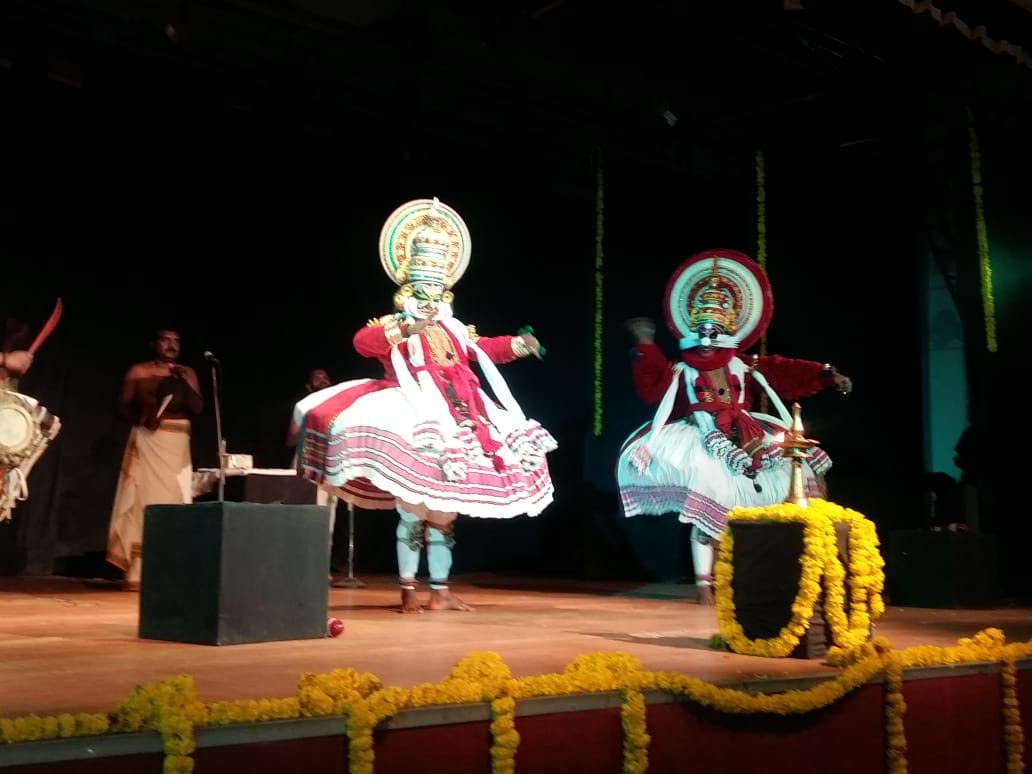
The day of 8th and 9th September 2018 with its festive occasion entitled ‘Malhar’ enchanted spectators in its spell-bound ecstasy and mystic aesthetics. Shilpgram, Udaipur bathed in the pours of rain showers welcomed the customized dancers and vocal and instrumental artists at its Darpan Sabhagaar under the aegis of WZCC, which runs under the patronization of the Ministry of Culture, Government of India.
 The planning, preparation and performance indeed are accredited to the laurels of the performing artists and their caliber. Needless to mention here the current officers of Rajasthan Administrative Services namely the Director Mr. Furkan Khan and the Additional Director Mr. Sudhanshu Singh with their friendly, organized, updated, enthusiastic team including Taneraj Sodha Sb., Bhupendra Kothariji, Durgeshji, C.P.Singhji Shivrati, Shoorveer Singhji Banediya, Nemrajji etc. have been into devoted mission to bring such commendable conviviality at such platform which is beyond the common man's reach. The duo officers’ visionary concept, approach, collaboration, dissemination of the available performing arts and its details via expert, acclaimed, awarded artists in itself is the prima facie of the truth that they have outreached the farthest available artistic sources in their credit, that speaks volume of their intensity and commitment to search and to bring in the theatre of Shilpgram year by year the newness in performing arts and to make possible the availability of celebrated and uncelebrated experts of the field.
The first performance that preceded the showcase of performing arts of the cultural heritage of India was from the dancing artists of Kerala. They enacted the event of "Dushashan's Slay" in which the fervent depiction of the scene dramatized by Panchali, Bhim and Lord Krishna from the Epic Mahabharat overwhelmed the audience with the conventional literary taste and art. The second presentation entranced the audience's Souls with deep-down splendor, beauty, and grace of the Odissi dance performers.The second day festivity on Malhar continued with the beginning of Mangalacharan, which was enacted by depicting Aarayi Pallavi Batlu Dance accompanied with the classical poetic gestures, emotions, and Shringaar rasa, and the lyrics were derived from Jaidev's classic book entitled "Geet Govind" "Dheerey Dheerey Yamuna Teerey......". It completely swayed the crowd of spectators in its spell on account of theatrical ambiance, perfect management of light and sound. The rainy showers pouring down outside the theatre and the resonating melody of instruments, and the gracious ornamental beauties was an absolute sight of mesmerizing captivity for the crowd of aesthetic taste and talent. The whole festive occasion culminated with the note of dramatic presentation of "Moksha", the Divine theatrical performances' message that one achieves transcendence while enacting or watching performing arts' manifestations when one completely merges one's Soul, Body and Mind with the artistic creations of Omnipresent. That has been for centuries across the globe has been interpreted as Enlightenment, Purgation, Creative Unity, Pure Consciousness and Self-Transcendence.


Sunday, 2 September 2018
Cultural Constructs and Legal Structures in Literary Discourses, Texts and Films -
The abundance of existing literary pieces across the globe demonstrates the cultural expectations acceptable in traditional and customary practices of society and surroundings. Whenever the cultural contexts are threatened, the legal context embraces the conflict and the controlled behavior. Therefore, cultural transmission is a manifestation of constituting cultural meaning, initiating discourse on law, or framing and reimagining law. The literary analyses examining cultural discourses and narratives render a valuable opportunity to negotiate legal and non-legal discourse in the conversational passages and in readings of the texts. The existing literature across the globe is a poetics that import legalities in literature or the literature with its complex hermeneutics manifests a lens of cultural meaning. In view of such critical scholarship in Humanities - the fiction writers and law fiction writers have been read respectively from the point of narrative legal genres and non-legal material, which in terms of Kelsenian legal philosophy theory has been classified as texts of transcendence, dualism, immanence, and pantheism. Many international acclaimed non-legal fiction writers such as Boccaccio, Hawthorne, Tolstoy, Kafka, Cather, Arimov, Chekhov, Rabindranath Tagore, Munshi Prechand, Salman Rushdie, V.S.Naipaul, besides the legal fiction writers such as John grisham, Steve Martin, William Diehl, Barbara Parkar, Brad Parks, etc. have dealt with implications of legality and its impact in cultural -social dicourse, which suggest a complex hermeneutic import of law and literature in the human life for their survival and sustenance. This Seminar opens up reader-centric possibilities and investigations in the existing pieces of literary texts in the light of deconstructing dichotomy of assumptions and presumptions, unveiling bad and good criticism in the cultural and social relationship, identifying and responding to the hermeneutic challenge, subverting the expectations of normative statutes.
Abstract Proposal within the limit of 200 words and the Biodata in 50 characters are to be submitted online before 20th September, 2018 to the email ID - profjayshree@bnuniversity.ac.in OR your abstract proposal can be directly uploaded for this Seminar after logging in www.acla.org webpage account of the Self.
Monday, 12 February 2018
Monday, 27 November 2017
B.N.P.G. College, Udaipur, Dept. of Eng. (Boys Wing Report 2012-2016) 27th...Nov.2017
https://drive.google.com/file/d/19lC9JdtfnYf3IbWo9Xa5BEAHjm3R9nw9/view
https://drive.google.com/file/d/0B2B4yLUStvLsVWNxX0dSVVJKSlU/view
Sunday, 5 November 2017
V.S. Naipaul’s Dialogic Perception for Religion and Rituals
https://warwick.ac.uk/fac/arts/ccs/icsa/events/conference2010/audio/?podcastItem=jayshree_singh.mp3
Jayshree Singh. V.S. Naipaul’s Dialogic Perception for Religion and Rituals
08:54, Sat 24 Jul 2010
Jayshree Singh. V.S. Naipaul’s Dialogic Perception for Religion and Rituals


Friday, 25 August 2017
Thursday, 2 February 2017
Call for Papers for LITERARIA: An International Journal of New Literature across the World Vol. 8, No. 1-2, Jan-Dec 2018
Call for Papers for LITERARIA: An International Journal of New Literature across the World Vol. 8, No. 1-2, Jan-Dec 2018
The cinematic vision is the lens that captures dilemma of ethics, aesthetics and logic in relation to physics and metaphysics. It reinforces the camera eye of human mind to revamp the past in terms of the present knowledge in order to reclaim the origin and history, besides to authenticate the fact of the human mind and nature. The cinematic visuals revert the understanding of practices, tensions and perception and contribute in seeking answers to cultural sovereignty or cultural slavery. The film directors, producers, screen-writers have been keen in presenting cinematic imagination viz-a-viz colonial structures, which mostly configures centralism, homogenizing influence of national-imperial opposition. The research articles and papers should attempt to answer analytically as well as critically with the help of their observations and cultural studies on the cinema - How do the postcolonial filmmakers resist oppositional strains of postindependence and pre-independence of their modern nation states? How do contradictory forces in a film reconfigure a new understanding of cultural politics and diverse epistemologies? How does a film challenge global concentration against dominant discourse of hegemonic culture? How do the film graphic, devices, techniques and cinematic strategies address nation, nationalism and decolonization? If the films redress such issues, then how do they absorb spectator-onscreen relationship to find alternative interpretations?
The research papers double-spaced, in not less than 4000 words and not exceeding 5000 words and book reviews in approx 1200 words should be submitted electronically in MS-Word and PDF file formats to the Guest Editor/Editors, at their e-mail addresses given below not later than 30th Oct 2017.
All papers submitted to LITERARIA should be original, neither having been previously published nor being considered elsewhere at the time of submission. Authors can send us the manuscripts according to the MLA Format given in the 8th edition of the MLA Handbook for Writers of Research Papers. Please indicate “LITERARIA: Ecological Perspectives in Literature and Media” in the subject line of all e-mail correspondence.
Guest Editor:
Dr. Jayshree Singh Associate Professor, Department of English Faculty of Social Science and Humanities Bhupal Nobles University, Udaipur 313001, Rajasthan, India.
E-mail: < dr.jayshree.singh@gmail.com> Ph: 9828375535
Editors:
Harpreet Kaur Bahri -
C/o BAHRI PUBLICATIONS
1749A/5, Govindpuri Extension
Kalkaji, New Delhi 110019
Ph: 9811204673, 9212794543
Special Issue on
(Colonial Imprints in Postcolonial Cinematic Eye)
The cinematic vision is the lens that captures dilemma of ethics, aesthetics and logic in relation to physics and metaphysics. It reinforces the camera eye of human mind to revamp the past in terms of the present knowledge in order to reclaim the origin and history, besides to authenticate the fact of the human mind and nature. The cinematic visuals revert the understanding of practices, tensions and perception and contribute in seeking answers to cultural sovereignty or cultural slavery. The film directors, producers, screen-writers have been keen in presenting cinematic imagination viz-a-viz colonial structures, which mostly configures centralism, homogenizing influence of national-imperial opposition. The research articles and papers should attempt to answer analytically as well as critically with the help of their observations and cultural studies on the cinema - How do the postcolonial filmmakers resist oppositional strains of postindependence and pre-independence of their modern nation states? How do contradictory forces in a film reconfigure a new understanding of cultural politics and diverse epistemologies? How does a film challenge global concentration against dominant discourse of hegemonic culture? How do the film graphic, devices, techniques and cinematic strategies address nation, nationalism and decolonization? If the films redress such issues, then how do they absorb spectator-onscreen relationship to find alternative interpretations?
The research papers double-spaced, in not less than 4000 words and not exceeding 5000 words and book reviews in approx 1200 words should be submitted electronically in MS-Word and PDF file formats to the Guest Editor/Editors, at their e-mail addresses given below not later than 30th Oct 2017.
All papers submitted to LITERARIA should be original, neither having been previously published nor being considered elsewhere at the time of submission. Authors can send us the manuscripts according to the MLA Format given in the 8th edition of the MLA Handbook for Writers of Research Papers. Please indicate “LITERARIA: Ecological Perspectives in Literature and Media” in the subject line of all e-mail correspondence.
Guest Editor:
Dr. Jayshree Singh Associate Professor, Department of English Faculty of Social Science and Humanities Bhupal Nobles University, Udaipur 313001, Rajasthan, India.
C/o BAHRI PUBLICATIONS
1749A/5, Govindpuri Extension
Kalkaji, New Delhi 110019
Ph: 9811204673, 9212794543
Saturday, 17 December 2016
Ethics-Aesthetics of Jaidev's Poetics GEET GOVIND in Udaipur


An amazingly ethereal profusion of spontaneity, melody, rhythm, beauty, truth, aesthetics, completely pious, pure, passionate, dedicated movements of dance in gestures, emotions and steps were felt by mesmerised and delighted spectators at Shilpgram theatre hall on 11 December 2016, Sunday from 6:30 pm to 9:00 pm. It was an occasion that commemorated the sweet strains of lyrics from the book entitled "Geet Govind" sung in praise and in devotion for the Supreme Almighty Lord Krishna by one of the early Medieval Indian History Laureate and renowned poet Jaidev. The performers were from young girls to youthful women, who embellished the the poetics with their kindled, enlightened art of Odissi dance, who have been mentored voluntarily for so long by the blessings of Guruji of Vrindavan, whose patronisation and motivation have not only enriched and enlivened the long, lost, precious, classical Indian literary piece through art of music and dance, but his kind dedication has relived the sensitivity of both spectators and performers all across India within a few years of its inception and conception. It has proved to be an offshoot for international cultural exchange and preservation of national heritage, which indeed needs more credits and acclamation, then what till it has received. Dr Pallavi Sharma, a gynaecologist in the Pannadhaya Hospital, Udaipur and her husband Dr Ashok Sharma along with their three daughters have been ardently pursuing this Odissi dance art to enact poetics of poet laureate Jaidev. The group comprising of lovely damsels with perfect bliss and coordination transcendentalised the varied artistic presentations while enacting the Gopis' love for Lord Krishna, the ten incarnations of the Infinite Form of Supreme Being on the Earth. The incredibility of its aesthetics seemed unending to suspend spectators' eyes on the commendable performative part of beautiful dancers of all age groups. The lovely little girls enacted the miraculous, enchanting pastimes of God Krishna; they performed on incantations sung in praise of God Shiva; they danced with piety on lyrics composed to invoke God's blessings; then all pretty damsels, with their performance, cherished audience heart with the musical dance sequences on Vasant Pallavi, Battuu Nritya, Madhurashtakam, Kalawati Pallavi, Kede Chandan etc. The spectators relished the blithe expressions manifested in motions of dancing steps of Vrindavan, who had been also acclaimed and felicitated by the Indian Council for Cultural Relations. The epitome of creative unity and aesthetics was visible in the participation and devotion of the dance performers such as Anuradha from Croatia and Chandramukhi from Switzerland. With the blessings of the mentor named Guruji, Venunaad Kala Kendra has carried far and wide, across the world by way of learning the rich and beautiful Odissi dance art and through their illustrious and glorious presentations. The dance performers were - Vrandawani Sharma, Arya Gupta, Anchal Bedi, Shireen, Kratavi, Navya Songh, Jhanvhi, Nehal, Sanskriti, Payal, Nandini, Rajeshwari Malhar, Dakshyami, Himanshi, Falguni, Shivika, Pallavi, Archana, Pawan Rajwaar. All sequences of dance performances were directed by the mentor of Odissi dance Shri. Pratap Narayan Mishra. The programme was anchored and coordinated by Momin Khan. The West Zone Additional Director Sh. Sudhanshu Singh presided the event. Dr Jayshree Singh and Mrs Anuradha Singh were the Special Guests, whose admiration for the performances prompted them to extend lots of appreciation and gratitude to have them the opportunity to watch the spectacular art of Odissi, performed by the young and adult trainees of the famous dancer and director of Venunaad Kala Kendra, on the poetics of Great Poet of India, Jaidev. Sh. Jaimal Singh Rathore extended his heartfelt adulation to performers, organisers, mentors, guests and audience.


Subscribe to:
Posts (Atom)